Fast Food and Obese Kids
Give enough information in your title so that a reader can decide if it is something that he or she wishes to read.


As explained in my first blog post, fast food has been targeted as being the cause of obesity in society's children for a while now. Though lawsuits against McDonald's and other restaurants have not been successful, they still prove that these places have a big part in this horrible act of obesity in our kids. No the "occasional cheeseburger" is not the cause of obesity in children, but these meals are not occasional anymore. It is becoming their everyday dinner. The process of these meals went from Kid’s Meals to Big Kid's Meals to Value Meals. This goes to show that our children are not even getting full off of “normal kid” servings anymore. An article by Vincent Iannelli, M.D. entitled Childhood Obesity: Who's To Blame explains how fast food plays a big part in children's obesity, but tells how there are others involved. This second party being the family or parents. "Busy and cash-strapped families increasingly rely on take-out food for family dinners," which proves the laziness of the parents. Jennie Murphy, in the article The Super-sizing of America: Are Fast Food chains to Blame for the Nation's Obesity?, tells how these fast food restaurants are "facing fierce competition for customer loyalty" so, they will basically do whatever is necessary to keep the customers coming, no matter the consequence; this consequence results in fat kids. Murphy also said that "the portions served by fast food chains and other restaurants are far larger than the recommended portion size for most foods." So, not only are they consuming unhealthy food, but also large portions of it.
Vegetarianism cannot possibly fix our environment, but it’s the easiest and most effective commitment an individual can make. Gidon Eshel, a geophysicist, and Pamela Martin, an assistant professor of geophysics at the University of Chicago, state that “if Americans were to reduce meat consumption by just 20 percent it would be as if we all switched from a standard sedan — a Camry, say — to the ultra-efficient Prius.”
By reducing consumption of meat or abstaining from it entirely, an individual reduces water pollution caused by the cattle and their waste reservoirs and air pollution caused by both the cattle’s’ carbon and methane emissions and the transportation of the meat.
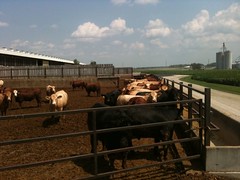
Over seventy percent of the grain grown in the country is used to fuel feedlots. Meat could be considered a weak investment in food production as they are very inefficient. It takes sixteen pounds of grain to grow—let’s admit it, you can hardly call it farming or raising, anymore—one pound of meat. It takes five pounds of wild fish to grow one pound of salmon (and an inferior salmon, at that!). “According to the USDA and the United Nations, using an acre of land to raise cattle for slaughter yields 20 pounds of usable protein. That same acre would yield 356 pounds of protein if soybeans were grown instead”[sic]more than 17 times as much!”
Imaging what we could do with all the grain, land, and water we’d save if we just committed to spending a little more time on dinner—if we just brought ethics to the table.
It’s cheaper to grab a burger and fries on your way home, but it shouldn’t be. Government subsidies favor corn and wheat (both used heavily on feedlots) so they can be sold below production costs and fruit and vegetable farmers aren’t united enough to even ask for government subsidy. If we were to reduce the amount of money given to grain and corn farmers, we could reduce the cost of produce—and supply nutritious food for the poor — and increase the price of “junk food” and meat.
I have been a lacto-ovo vegetarian for almost fifteen years. I abstain from eating meat, although I’ll eat eggs, milk, and the products of animals, generally. Oddly, enough, I made this decision when I was around four years old—obviously, it wasn’t a logical one, at the time, but I found that as I grew older, I created reasons for myself after the fact; they weren’t half bad.
Going vegetarian is pretty much the single greatest impact you can make for the sake of the environment. Methane is over twenty times as powerful as any other greenhouse gas; it’s responsible for more global warming than all other greenhouse gases combined. Concentrations of animal waste and cattle farms contribute over one hundred million tons of methane per year. Water tables are polluted from the nitrogen in the cattle’s urine. The nitrates could contaminate wells and drinking water. An individual cow wouldn’t contribute anything too terribly serious; however, farming has grown from a small-scale and personal experience into a giant process. We’ve taken
I’m not saying that these are evil Mega-corporations and we should form a lynch mob or anything. If the surgeon general and the FDA require tobacco companies to label cigarettes as dangerous carcinogens, is it really too much to ask for some regulation regarding something as vital as our food? I’m all for the individual’s responsibility to educate themselves, but it’s undeniable that the conditions regarding our food are kept, for the most part, in the dark. If we’re staying for dinner, is it really too much to ask to just have a peek in the kitchen?