In the United States, oil companies have already gained permission to drill in many different places, so why harm ANWR? Where else could you find caribou frolicking or beautiful scenery as you would in the ANWR region? I know America spends a lot on foreign oil, however, why should our government’s problems have an effect the natural habitat of Alaska’s animals.
While I still stand against destroying the environment for oil purposes, I understand that oil is necessary for our planet to survive. Though there are many alternative ways being created to fuel cars, the process is taking a long time, and many people aren’t taking advantage of the alternatives.
While continuing my research relating to saving ANWR, I came across a blog written by Sheryl Canter, who shares the same viewpoints as I. What she also opened my eyes to was the fact that ANWR’s total amount of oil would be nothing compared to the 21 billion gallons of oil that Americans burn daily!
Another problem with drilling is the fact that oil use is considered one of the leading causes of global warming. Supporters of drilling in ANWR obviously do not understand the harsh ecological consequences, or are too selfish to care. Overall, ANWR, Arctic National Wildlife Refuge, should be saved considering the fact that it is a “Wildlife Refuge!”
Showing posts with label Oil. Show all posts
Showing posts with label Oil. Show all posts
Friday, October 22, 2010

Tuesday, October 12, 2010
Hi, My Name is Humanity, and I'm an Oil Addict.


In my last entry I claimed that the phenomena of peak oil would cause great economic and social hardships on the entire world. Here I hope to shed light on the more specific threats we can expect to see in the coming decades. Many may argue that they are perfectly content to just ride a bicycle or that they have no need for a car where they live, and a few people even claim they would be fine without electricity and all of the work that entails. However, this is not the extent of the problem. The problem is that all of us, regardless of our attachment to modern luxury, have to eat to survive and currently the worlds agriculture is very heavily dependent on oil. In a recent article published in the The Salt Lake Tribune it was bluntly stated that,
"Inhabitants of the United States literally eat oil. Oil is necessary to make the fertilizer and pesticides used on our crops; to irrigate them; and to fuel the machinery used to plant, cultivate, and harvest them. In one study conducted in 1994, it was calculated that feeding each American each year required the equivalent of 400 gallons of oil, exclusive of the energy, mainly oil, needed for packaging, refrigeration, transportation, and cooking. The authors calculated that for every calorie of food energy delivered to the consumer, 10 calories of other energy, mostly oil, are required. The lesson is clear: Without oil we starve."Human life will go on without many of oils products such as the transportation, electronics and machinery but a break down in the farming system leads to famine. Human population has doubled in roughly 60 years and our oil consumption has increased even more exponentially. Traditional, pre-oil agriculture simply cannot feed 7 billion people. In a report sponsored by the European Union it was determined that the greatly enhanced yields from hydrocarbon aided farming produces about 75% of the worlds grain and feeds roughly 60% of the human population. As it stands, that is almost 4 billion people. Anything but the most optimistic of view points is rather troubling when all of this is considered.
Wednesday, October 6, 2010
Save ANWR
America has become so dependent on oil, it seems as if the government would go to any measure to obtain it, even if it comes to destroying natural animal habitats and moving small communities. The Arctic National Wildlife Refuge (ANWR) is the United State's largest wildlife refuge, spreading across 19 million acres  of northern Alaska. The part of ANWR that would be used for oil and gas development is considered to contain billions of gallons of oil, along with trillions of cubic feet of natural gas. Along with all the oil and gas, ANWR also contains a fragile ecosystem.
The debate on whether or not to drill for the much needed oil has been going on for years. According to the Defenders of Wildlife article, Wildlife Impacts from Oil Drilling in the Refuge, the portion of ANWR set aside for oil and gas development is the 1.5 million acres of coast along the Beaufort Sea. President George W. Bush proposed that the oil found in ANWR would reduce our dependence on foreign oil by one million barrels a day. Is it worth destroying the environment?
According to Jeffery A. Hank's article, ANWR & Oil: What About the Wildlife, drilling in ANWR would provide America with oil and gas, however at the same time it would ruin the beauty of the land. Numerous animals call this land home, and many migrate across it each year. It would be selfish of our government to ruin one of America's last frontiers only for extra oil. It should be no question that the beautiful wildlife and picturesque terrain should stay unharmed from oil rigs.
There are also small communities that call ANWR home; the Gwich'en people and the Inupiat Eskimo tribe. Though the two groups support oil drilling on their land, it may also cause them harm. With the building of oil rigs, many job opportunities will arise for the people. However, the question these groups face is deciding between earning money and preserving land.
 of northern Alaska. The part of ANWR that would be used for oil and gas development is considered to contain billions of gallons of oil, along with trillions of cubic feet of natural gas. Along with all the oil and gas, ANWR also contains a fragile ecosystem.
The debate on whether or not to drill for the much needed oil has been going on for years. According to the Defenders of Wildlife article, Wildlife Impacts from Oil Drilling in the Refuge, the portion of ANWR set aside for oil and gas development is the 1.5 million acres of coast along the Beaufort Sea. President George W. Bush proposed that the oil found in ANWR would reduce our dependence on foreign oil by one million barrels a day. Is it worth destroying the environment?
According to Jeffery A. Hank's article, ANWR & Oil: What About the Wildlife, drilling in ANWR would provide America with oil and gas, however at the same time it would ruin the beauty of the land. Numerous animals call this land home, and many migrate across it each year. It would be selfish of our government to ruin one of America's last frontiers only for extra oil. It should be no question that the beautiful wildlife and picturesque terrain should stay unharmed from oil rigs.
There are also small communities that call ANWR home; the Gwich'en people and the Inupiat Eskimo tribe. Though the two groups support oil drilling on their land, it may also cause them harm. With the building of oil rigs, many job opportunities will arise for the people. However, the question these groups face is deciding between earning money and preserving land.
Friday, October 1, 2010
Hi, My Name is Humanity, and I'm an Oil Addict.


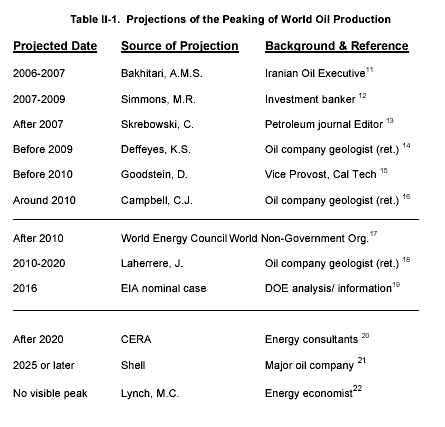
Our species has become hopelessly dependent on a non renewable resource for its most basic needs. We consume over 85 million barrels of it everyday. Oil and other hydrocarbon fuel types power every aspect of our modern lives. This is not a "go green" sermon, this is not a climate change debate. This deals with a phenomena that we are certain will happen soon and it is called peak oil. Peak oil is described as the point in time when global oil production has peaked and then enters a terminal decline, as it is a finite resource and subject to depletion.
To help illustrate how important oil is to all of us, lets take a moment to look at what we would lose without it. Hydrocarbons provide the bulk of the energy needed in modern manufacturing. Therefore, every product in your house and the house itself is essentially an oil product. Oil's importance to all modern forms of transportation is obvious. All of our food and goods are transported over great distances with vehicles that burn gasoline. Certainly the most frightening issue is that our current method of agriculture depends entirely on oil. Without the gas powered machines and petroleum based fertilizers and pesticides, we would not be able to produce enough food for our growing population. As scarcity of oil increases, so will the price of every product and service that requires it. If this decline in oil production happens as sharply as some predict, we are in for one of the most difficult times in human history.
Dr. Robert L. Hirsch, a Senior Energy Advisor for Management Information Systems Inc led a study for the U.S. Department of Energy on the subject of peak oil and said,
"The peaking of world oil production presents the U.S. and the world with an unprecedented risk management problem. As peaking is approached, liquid fuel prices and price volatility will increase dramatically, and, without timely mitigation, the economic, social, and political costs will be unprecedented. Viable mitigation options exist on both the supply and demand sides, but to have substantial impact, they must be initiated more than a decade in advance of peaking."
Many experts predict this peak will occur between 2010 and 2020. There is no easy answer to this problem and it will take a combination of solutions and sacrifices to get through this period with our population in tact. Its going to take a combination of strict conservation, heavier reliance on alternative energy sources, more efficient vehicles, better oil extraction methods and new technologies in chemical fuels to replace the void that cheap oil will leave.
Subscribe to:
Posts (Atom)